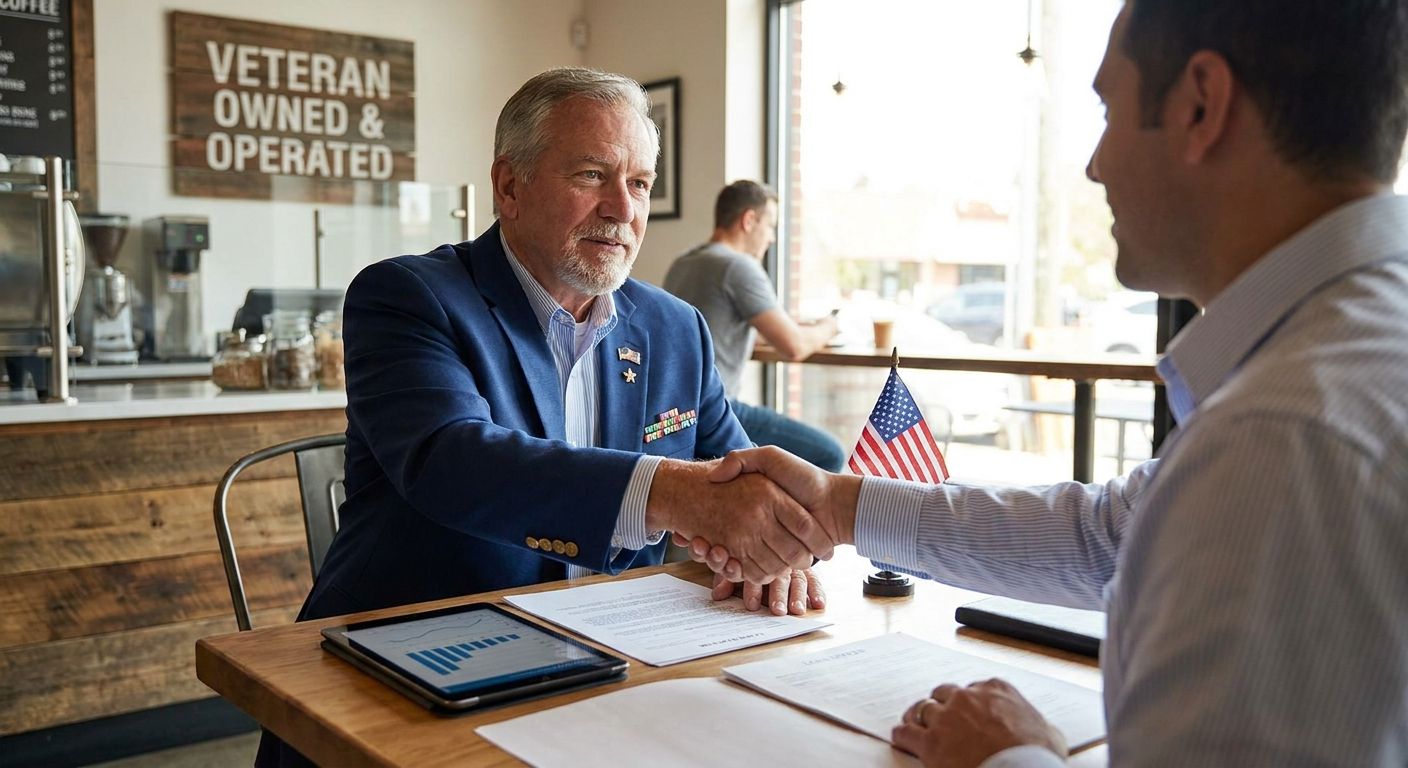
Veteran-owned business SBA loans give companies at least 51% owned by a veteran access to government-backed financing through the SBA 7(a), 504, and Express programs, usually at lower rates than merchant cash advances or short-term working capital. The tradeoff is timeline: standard SBA 7(a) loans take 60 to 90 days from application to funding, which is a problem when payroll or a supplier deposit is due next week.
- SBA loans for veteran-owned businesses run through the same 7(a), 504, and Express programs as any small business, with veteran-specific fee relief on the upfront guaranty fee.
- SBA 7(a) tops out at $5 million; SBA Express funds up to $500,000 with a faster SBA review window.
- In 2026, only 42% of small business financing applicants got the full amount they requested and 22% got nothing, which is why a bridge plan matters.
- Jon Lynch Financial Group structures working capital and revenue-based financing to cover the 60-90 day SBA gap without derailing the SBA application.
- Bank statement quality, not just credit score, drives approval odds for both SBA and alternative funding paths.
Why SBA loans matter for veteran-owned businesses
Veteran-owned businesses qualify for the same SBA underwriting as any small business, but two things change the math: fee relief on the upfront guaranty fee for qualifying veteran-owned loans, and a documentation layer most owners underestimate. SDVOSB and VOSB certification paperwork, DD-214 verification, and ownership structure proof all sit on top of the standard SBA package.
The bigger issue in 2026 isn't eligibility, it's timing. Only 42% of small business financing applicants got the full amount they sought in 2026, and 22% got nothing at all. SBA loans are the cheapest capital on the table for veteran-owned businesses, but they are not fast capital. Most owners who lose deals or miss payroll while waiting on an SBA decision didn't get denied — they just didn't have a bridge plan.
Update your eligibility documentation first
Ownership and control questions kill more SBA applications for veteran-owned businesses than credit score does. Get this locked before you submit anything.
- Confirm at least 51% ownership by one or more veterans, documented in your operating agreement or cap table
- Pull DD-214 forms for every veteran owner claiming eligibility
- Decide between VOSB self-certification and formal SDVOSB certification through the VA, since they serve different purposes (SDVOSB matters for federal contracting set-asides, not SBA loan eligibility itself)
- Verify management control sits with the veteran owner, not a non-veteran majority partner or silent investor
- Match your entity's legal name and EIN across every document in the package
Pick the right SBA loan structure for your goal
SBA is not one product. Matching the structure to the actual use of funds shortens underwriting and avoids a rejected application that resets your clock.
- SBA 7(a): up to $5 million, the most flexible option for working capital, acquisition, refinancing, or equipment
- SBA 504: built for real estate and major fixed-asset purchases, structured with a bank first lien, a CDC second lien, and a borrower down payment
- SBA Express: caps at $500,000 but carries a faster SBA-side review, useful when timeline matters more than loan size
- SBA Microloans: smaller amounts, often under $50,000, run through nonprofit intermediaries rather than banks
- Match the program to use of funds before you pick a lender — a bank asked to fund a 504 deal as a 7(a) will slow you down
Prepare your bank statements before you apply
SBA underwriters and any alternative lender you fall back on look at the same core signals. Clean these up 60-90 days before you apply, not the week you submit.
- Average daily balance trend over the trailing three to six months
- Total deposit count and consistency month over month
- NSF occurrences — even two or three in a quarter raise flags
- Negative-balance days, which weigh heavier than raw deposit totals
- Personal and business tax returns reconciled against bank deposits
- Existing debt schedule, including any merchant cash advance balances
Address FICO and time-in-business gaps honestly
SBA lenders generally want stronger personal credit than alternative funders will accept. If your veteran-owned business doesn't clear that bar yet, know your position before you apply.
- SBA lenders typically look for credit in the mid-600s or higher on the guarantor
- Alternative financing, including revenue-based options, can work with FICO scores in the 550+ range when cash flow supports it
- Time in business under two years pushes most SBA lenders toward 504 or Express rather than a standard 7(a)
- A co-signer or additional guarantor can offset a thin credit file without changing your entity structure
- Document any recent credit events (late payments, collections) with a one-page explanation letter — underwriters read these
Bridge the SBA funding gap with short-term capital
This is where most veteran-owned businesses lose ground. A 60-90 day SBA timeline doesn't pause your payroll, your supplier terms, or a seasonal inventory buy. Revenue-based financing and working capital facilities exist specifically to cover that window without disqualifying you from the SBA loan you're still waiting on.
Construction contractors and trucking companies run into this constantly — a job starts before the SBA equipment loan clears, or a load needs fuel advances now. Jon Lynch Financial Group structures working capital loans for construction contractors and merchant cash advances for trucking companies built for exactly this gap: funding in 24-48 hours against revenue, not against the SBA collateral package. A bridge advance should never carry the same collateral pledge as your SBA loan — keep the two structures separate or you complicate the SBA closing.
“A 1.35 factor rate on a 12-month advance is not the same cost as a 35% APR SBA loan — compare the total dollar cost, not the headline number.”
Compare SBA lenders and brokers before signing
Not every bank runs SBA loans the same way. Some community banks close 7(a) deals in 45 days; some national banks take twice that.
- Ask for average SBA closing time on the specific program you need, not a generic answer
- Confirm whether the lender sells the guaranteed portion on the secondary market (affects nothing for you directly, but signals volume and experience)
- Get the full fee schedule in writing: packaging fees, guaranty fee, any broker fee
- Ask how many veteran-owned SBA deals the lender or broker closed in the last 12 months
- Verify the lender is on the SBA's approved lender list for the program you're using
Track your timeline and build a fallback
Applications stall. Build the fallback before you need it, not after week six of silence.
- Set a hard decision date — if you haven't heard back in 30 days, escalate or start a parallel application
- Line up a working capital or revenue-based financing option in advance so it's not a panic decision
- Keep bank statements current throughout the SBA process; a three-month-old statement package ages out fast
- Confirm your CDC or bank's required documents list hasn't changed mid-application
Comparing your options
| Option | Best For | Typical Funding Timeline | Key Limitation |
|---|---|---|---|
| SBA 7(a) | Working capital, acquisitions, refinancing up to $5M | 60-90 days | Slowest option; heavy documentation |
| SBA 504 | Real estate and major equipment purchases | 60-90 days | Structured multi-lender closing, not for working capital |
| SBA Express | Smaller amounts up to $500K with faster review | 30-45 days | Lower loan cap; still a full application |
| Revenue-based financing / MCA | Bridging cash flow gaps while SBA is pending | 24-48 hours | Higher cost per dollar than SBA; shorter terms |
Verdict: SBA loans win on cost for veteran-owned businesses that can wait 60-90 days; revenue-based financing wins on speed when the business can't.
Compare your funding timeline
Talk through SBA advisory and bridge financing options for your business.
Common mistakes veteran-owned businesses make
- Assuming veteran status speeds up SBA approval. It doesn't change underwriting speed; it can reduce fees, not timeline.
- Submitting SDVOSB paperwork inconsistent with the loan application entity name. Mismatched EINs or ownership percentages between certification filings and loan docs restart underwriting.
- Applying for SBA financing with no bridge plan. With 22% of 2026 applicants getting nothing and 42% getting the full amount, the middle group waited weeks for a partial answer while operations stalled.
- Comparing a factor rate directly to an SBA APR. A 1.35 factor rate on a $100,000 advance over 12 months is a different cost structure than a percentage-rate SBA loan — run both to actual dollars before deciding.
- Letting bank statements go stale mid-application. A statement package that was clean in month one but shows two NSFs by month three can downgrade your file without anyone telling you why.
FAQ
What SBA loans are available for veteran-owned businesses in 2026?
Veteran-owned businesses can apply for SBA 7(a) loans up to $5 million, SBA 504 loans for real estate and equipment, SBA Express loans up to $500,000, and SBA Microloans for smaller amounts. Veteran-owned businesses use the same programs as any small business, with fee relief available on the upfront guaranty fee for qualifying loans.
How long does an SBA loan take to fund for a veteran-owned business?
Standard SBA 7(a) and 504 loans take 60 to 90 days from application to funding in 2026. SBA Express loans move faster, typically closing in 30 to 45 days because of a shorter SBA review window.
Do veteran-owned businesses get lower SBA loan fees?
SBA fee relief programs can reduce or eliminate the upfront guaranty fee for qualifying veteran-owned businesses. This lowers the total cost of the loan but does not change the underwriting timeline.
Is SDVOSB certification required to get an SBA loan?
No. SDVOSB certification matters for federal contracting set-asides, not SBA loan eligibility. SBA loan programs require veteran ownership documentation, not formal SDVOSB status.
What credit score do I need for an SBA loan as a veteran-owned business?
SBA lenders generally want personal credit in the mid-600s or higher on the guarantor. Businesses with FICO scores closer to 550 typically look at revenue-based financing or a merchant cash advance instead.
Can a veteran-owned business get a bridge loan while an SBA application is pending?
Yes. Revenue-based financing and working capital facilities can fund in 24-48 hours to cover cash flow gaps while an SBA 7(a) or 504 loan is still in underwriting.
What's the difference between VOSB and SDVOSB for business owners?
VOSB requires 51% ownership by a veteran with no disability requirement. SDVOSB requires 51% ownership and control by one or more service-disabled veterans and is used mainly for federal contracting eligibility, not SBA lending.
How much can a veteran-owned business borrow through SBA 7(a)?
SBA 7(a) loans go up to $5 million. The actual amount approved depends on cash flow, collateral, and use of funds, not veteran status alone.
One last thing
The SBA 504 program's structure catches most first-time applicants off guard: a bank funds up to 50% as the first lien, a Certified Development Company funds up to 40% as a second lien, and the borrower puts down as little as 10% — three separate parties, three separate closings, one deal. Veteran-owned businesses buying real estate or heavy equipment in 2026 should budget an extra two to three weeks just for the CDC side to sync with the bank's timeline.